Safety observation software built for the front line
Capture safe and unsafe behaviors from any device, assign corrective actions with due dates, and see participation and closure rates across every site.
Request a demo


Trusted by Leading EHS Teams


> Why SafetyIQ
Build a safety culture you can actually measure
Observations only prevent incidents when they're easy to capture and impossible to ignore. SafetyIQ makes both happen.
01
Easy for everyone to report
Anyone can log a safe or unsafe observation from their phone in seconds, with photos attached.
02
Every unsafe act gets an owner
Corrective actions are assigned with due dates and reminders, so nothing sits open without someone responsible.
03
Leading indicators, not lagging ones
Track participation, hazard categories and closure times to spot trends before they turn into incidents.
> How it works
Capture, act and improve, all in one place
A behavior-based safety program that runs itself, from the first observation to the trend that changes how you work.
01 · Capture
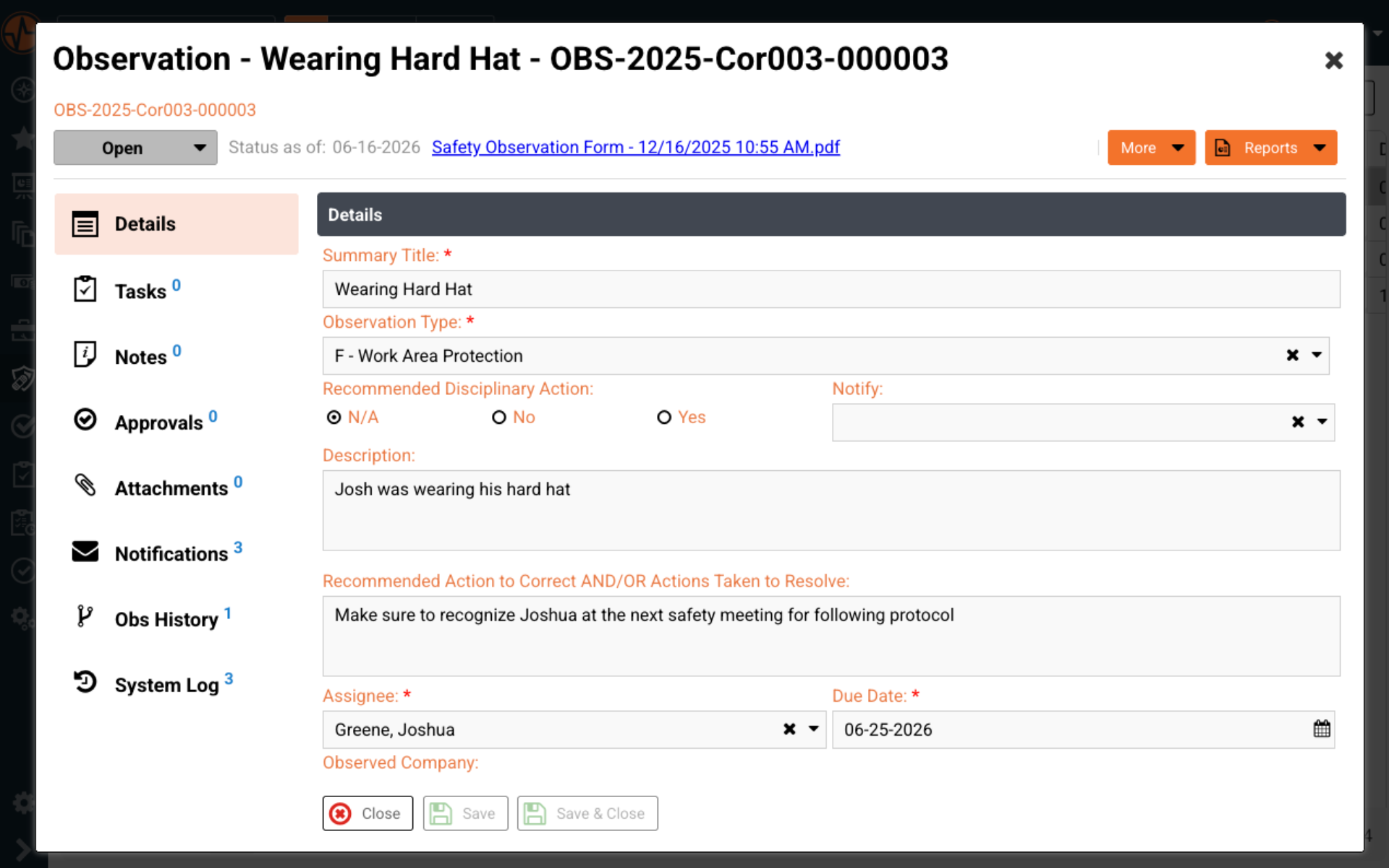
Record every observation in full detail
Capture what was seen, what action was recommended, who owns it and when it's due, so nothing is left ambiguous.
- ✓Record safe and unsafe behaviors
- ✓Photos attached directly to the record
- ✓Full history and notification trail
02 · Act
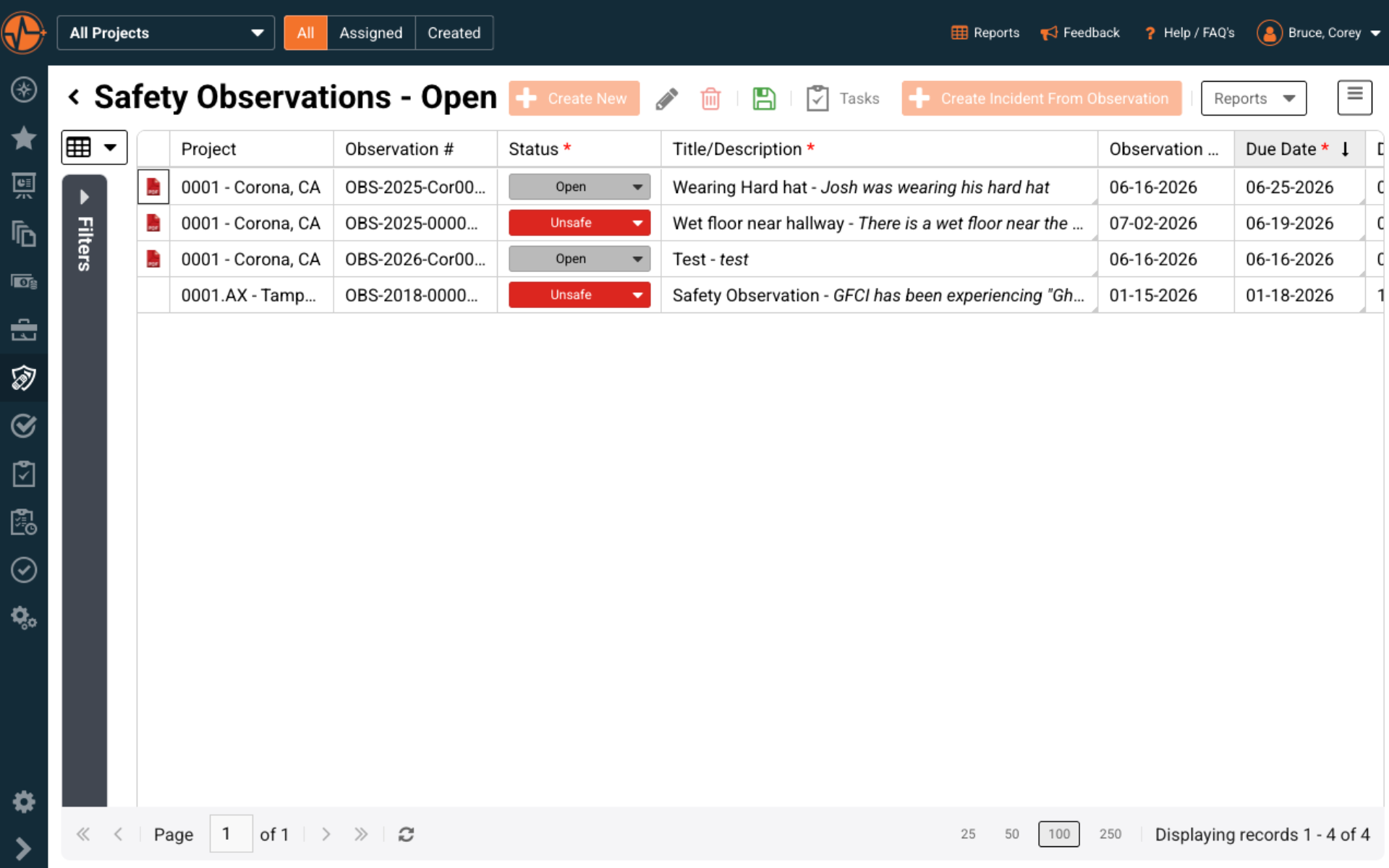
See every open and unsafe observation
A live, filterable view of open and unsafe observations across every project, so supervisors can prioritize what needs action.
- ✓Filter by project, assignee, priority or status
- ✓Corrective actions with owners and due dates
- ✓Escalate to an incident with one action
03 · Improve
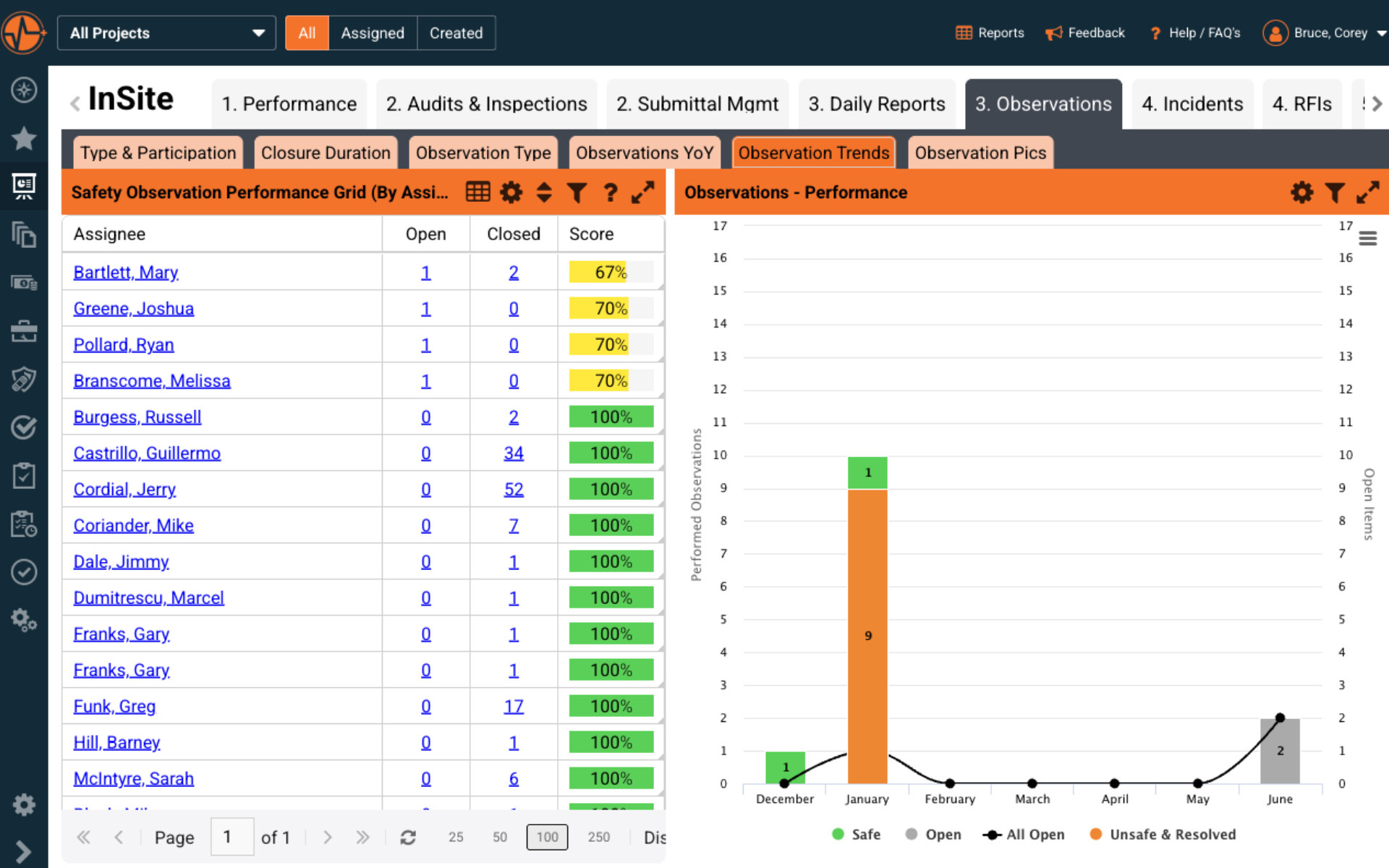
Know who is engaged and where hazards cluster
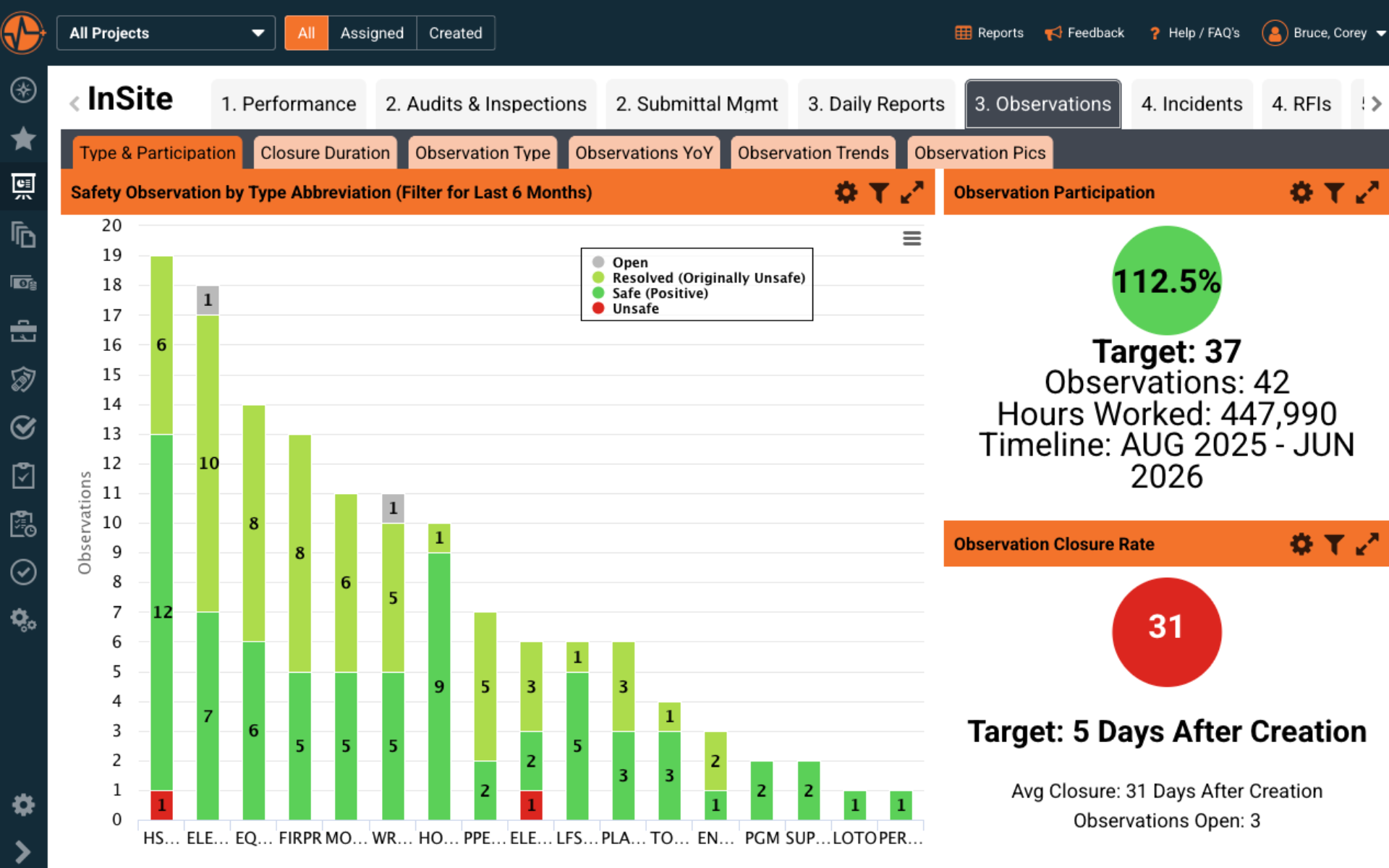
Measure participation against targets, see which hazard types occur most, and track how quickly unsafe observations get closed.
- ✓Participation tracked against program targets
- ✓Closure time by hazard category
- ✓Assignee performance scored and ranked
> The difference
What changes when observations stop living on paper
Most observation programs start on cards and clipboards. Here is what that looks like with and without SafetyIQ.
> Customer story
now reports observations, incidents and audits to one standard
TrueNorth Steel, a U.S. steel manufacturer with 800+ employees across multiple facilities, replaced disconnected tools with SafetyIQ's Safety Observations, Incidents, Audits and SDS modules, so site-level learnings are shared company-wide.
With SafetyIQ, ‘the data doesn’t lie.’ Our team can now rely on clean, organized data for accurate, real-time safety insights across all sites.
> Works with
Connect observations to the rest of your safety program
Observations surface hazards. These modules help you act on them.
When an observation becomes an incident
Incident Management
Simplify reporting, recording, and turn every incident into prevention.
When a hazard needs a risk assessment
Hazard & Risk Management
Identify hazards early and address them before they lead to safety incidents.
When a site needs a closer look
Audits & Inspections
Stay audit-ready year-round with fast, paper-free audits and inspections.
When a behavior needs retraining
Training Tracking
Assign, track, and manage training so your workforce stays prepared and compliant.
> Not ready for a demo?
Get the free Safety Observations Guide
Turn any worker into a safety champion with practical guidance on running an observation program your crews will actually use.
> FAQ
Safety observations and BBS software FAQs
What Is Safety Observation Software and How Does It Support a BBS Program?
Safety observation software is a digital tool that helps organizations capture, track, and act on workplace observations — both safe behaviors and unsafe conditions — in a structured, consistent way. In a behavior-based safety program, the observation process is the engine that drives everything else. Workers and supervisors document what they see in the field, those observations are analyzed for patterns, and the insights are used to reinforce positive behaviors and correct unsafe ones before they lead to an incident. Without a reliable system behind it, a BBS program tends to fall back on paper forms, spreadsheets, and manual follow-up — all of which create gaps in data, slow down corrective actions, and make it nearly impossible to measure whether the program is actually working.
Purpose-built safety observation software solves those problems by centralizing the entire process: from the moment an observation is submitted to the moment the corrective action is closed, everything is tracked, timestamped, and reportable. For organizations serious about building a proactive safety culture, it's the difference between a BBS program that runs on good intentions and one that produces measurable results.
What Types of Observations Should Be Captured in a BBS Program?
A well-run behavior-based safety program captures both ends of the spectrum — not just unsafe conditions and at-risk behaviors, but safe behaviors and positive practices as well. This balance is important because BBS is fundamentally about reinforcing what's working, not just correcting what isn't. If a program only documents problems, it creates a culture where workers associate observations with discipline rather than improvement, which suppresses reporting and erodes trust. On the unsafe side, observations should capture at-risk behaviors, hazardous conditions, PPE non-compliance, procedural shortcuts, and environmental hazards — anything that could contribute to an incident if left unaddressed.
On the safe side, observations should document workers following procedures correctly, using PPE as required, identifying hazards proactively, and demonstrating safety leadership. Over time, the ratio of positive to corrective observations, and the trends within each category, tells a clear story about where the safety culture is strong and where it needs work. The most effective programs also capture near-misses as a distinct observation type — these are among the most valuable data points a safety team can collect, because they reveal real failure paths before they result in injury.
How Do You Measure the Effectiveness of a Safety Observation Program?
Measuring the effectiveness of a safety observation program requires looking beyond simple submission counts. Volume matters — a program where observations are rarely submitted is a program where workers aren't engaged — but it's a starting point, not a measure of quality. Participation rate, meaning the proportion of workers or supervisors who are actively submitting observations relative to your target, is one of the most important leading indicators of program health. Closure rate and closure duration tell you whether the corrective actions generated by observations are actually being completed, and how quickly. An organization that captures hundreds of unsafe observations but closes them slowly — or not at all — is generating data without generating improvement.
Observation type distribution reveals whether the program is balanced between positive and corrective observations, and whether certain hazard categories are appearing repeatedly. That kind of pattern signals a systemic issue that requires something more than individual corrective actions. Trend analysis over time — are unsafe observations increasing or decreasing in specific categories, on specific sites, or under specific supervisors — is where the program starts to generate genuinely predictive insights. Organizations with mature safety observation programs use this data to anticipate where incidents are most likely to occur and intervene before they do, rather than analyzing what went wrong after the fact.
What Is the Difference Between a Safety Observation and a Safety Incident Report?
A safety observation and a safety incident report serve different purposes and capture different types of events, though they're part of the same continuum of safety management. A safety observation documents something a worker or supervisor notices in the field — a behavior, a condition, a practice, or an environment that is either safe and worth reinforcing or unsafe and worth correcting. Importantly, an observation doesn't require anything to have gone wrong. It's a proactive activity designed to identify risk before it materializes.
A safety incident report, by contrast, documents something that has already happened — an injury, a near-miss, property damage, or an environmental release. It's a reactive record of an event that occurred. The relationship between the two is significant: organizations with strong observation programs tend to generate more near-miss and hazard reports, which in turn tends to correlate with fewer serious incidents over time. When an observation reveals a condition or behavior serious enough to warrant escalation, it should be able to flow directly into an incident management process without duplication of effort. The two systems work best when they're integrated — observations feeding early warning signals into the same platform that manages incident investigations and corrective actions.
How Do You Get Workers to Consistently Participate in Safety Observations?
Worker participation is the most common challenge in any behavior-based safety program, and it almost always comes down to the same root causes: the process is too cumbersome, workers don't see their observations leading to any visible action, or there's a cultural hesitation around documenting unsafe behaviors for fear of consequences. Addressing participation starts with making the submission process as easy as possible — observations should be submittable from a mobile device in the field in a matter of minutes, not require workers to find a computer or fill out a lengthy paper form at the end of a shift. When friction is low, participation goes up. Beyond ease of use, the feedback loop matters enormously. Workers who submit an observation and never hear what happened to it will stop submitting.
Organizations that close the loop — acknowledging what was reported, communicating what action was taken, and recognizing workers who contribute regularly — build the kind of trust that sustains long-term participation. Leadership visibility is also critical. When supervisors and managers are seen actively submitting observations themselves, it signals that the program is a genuine organizational priority rather than an obligation imposed on the workforce. Finally, recognition plays a meaningful role. Publicly acknowledging workers who submit high-quality observations, or who identify hazards that led to meaningful changes, reinforces the behavior you want to see — which is, after all, exactly what behavior-based safety is designed to do.
Turn every observation into prevention
See how SafetyIQ's mobile observations, corrective actions and participation dashboards fit your sites and teams, in a demo built around how your people work.
Request a demoGet a demo built around your sites, your teams, and the way your people work.
EHS, journey, and fatigue management software for field-heavy teams.

.png)

.png)