
EHS software your whole operation will happily use
Incidents, inspections, observations, corrective actions and compliance records in one mobile-first platform, built for field-heavy teams and connected across every site and module.
Request a demo

Trusted by Leading EHS Teams







> Why SafetyIQ
One system for every stage of your EHS program
Replace spreadsheets, paper forms and disconnected tools with one platform that frontline workers, managers and leadership all work from.
01
Unify your safety data
Track incidents, hazards, audits and corrective actions in one connected system instead of a stack of spreadsheets.
02
Work anywhere, even offline
Record on any phone or tablet, including remote and underground sites, and sync automatically once back in range.
03
Automate the follow-up
Assign corrective actions, send deadline reminders and escalate overdue tasks without manual chasing.
> The platform
Twelve modules. One connected safety record.
Every observation, inspection, action and document lands in the same place, so nothing falls between systems and every site works the same way.
01 · Capture risk
Spot it and report it
Give everyone a fast way to report what they see, the moment they see it.
02 · Control the work
Keep work under control
Manage the people, equipment and changes that create risk in the first place.
03 · Prove compliance
Stay audit-ready
Keep every record current, searchable and ready for an auditor or investigator.
> Built for every role
From the frontline to the boardroom
SafetyIQ adapts to the way your organization operates, giving everyone the right tools and the right view.
01 · In the field
Report in seconds, from any device
Frontline workers log incidents, hazards and observations on the spot, with photos and details captured while they're fresh.
- ✓Incidents, hazards and near misses from any phone or tablet
- ✓Photos, notes and signatures captured in the field
- ✓Full offline mode that syncs once connectivity returns

02 · For managers
Assign, track and close every action
Managers see what's open across sites and projects, and SafetyIQ does the chasing.
- ✓Corrective actions with owners and due dates
- ✓Automatic reminders and escalation for overdue tasks
- ✓Filter by site, project, contractor or status


03 · For leadership
See risk across every site
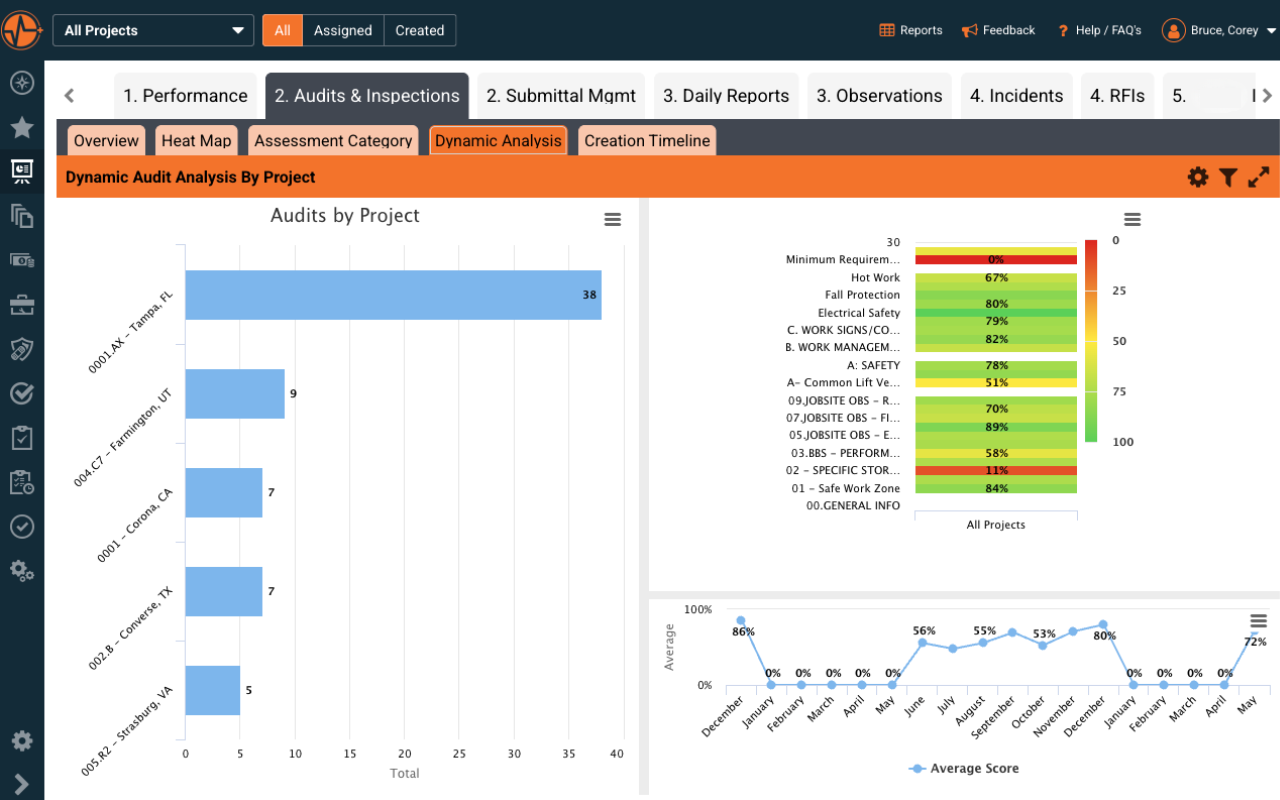
Leaders get clear visibility into safety performance across every site, region and program, without waiting for a monthly report.
- ✓Real-time dashboards across every site
- ✓Trends across incidents, audits and observations
- ✓Timestamped, audit-ready reports by site, team or date
.png)

> Customer proof
Safety teams that moved beyond paper and spreadsheets
From aerospace to steel fabrication, here is what changed when their EHS program moved onto one platform.
cut from workers' comp direct costs in two years
“…there is plenty of evidence of what a good safety management system can do to benefit a company.”
SafetyIQ allowed us to do observations easily. Where you see it, you take a picture of it, and then you can actually assign it to someone, so you have ownership.
With SafetyIQ, ‘the data doesn’t lie.’ Our team can now rely on clean, organized data for accurate, real-time safety insights across all sites.
> The difference
What changes when EHS moves off spreadsheets
Most EHS programs outgrow paper, email and spreadsheets long before they replace them. Here is what that looks like with and without SafetyIQ.
Customer Reviews of SafetyIQ
Real EHS teams improving their safety cultures with SafetyIQ. Discover how safety, risk and compliance leaders are using our platform to unify their programs, build proactive safety engagement, and drive measurable cultural change across their organizations.



> Not ready for a demo?
Build the case for EHS software
Get the eBook on securing leadership buy-in for safety management software, written for safety leaders making the case internally.
> FAQ
EHS management software FAQs
What Is EHS Management Software?
EHS management software is a centralized system used by organizations to manage environmental, health, and safety programs in a structured and consistent way. Instead of relying on spreadsheets, paper forms, or disconnected tools, EHS software brings together incident reporting, inspections, audits, corrective actions, training records, and compliance documentation into one platform. This centralization helps ensure that safety processes are applied consistently across locations, teams, and job roles.
Beyond record keeping, EHS software supports proactive risk management. It allows organizations to identify patterns in incidents and near misses, track recurring hazards, and monitor the effectiveness of safety controls over time. By turning safety activity into structured data, EHS software enables better decision-making and clearer accountability throughout the organization.
Why Is EHS Software Important for Compliance in 2026?
EHS software plays a critical role in compliance because regulatory requirements demand consistency, documentation, and traceability. Many environmental and safety regulations require organizations to demonstrate that inspections are performed, incidents are investigated, corrective actions are completed, and training is maintained. Manual systems often struggle to meet these expectations, especially as organizations grow or operate across multiple sites.
By automating workflows and maintaining a complete audit trail, EHS software helps ensure that compliance activities are completed on time and documented accurately. When inspections or corrective actions are overdue, the system can surface those gaps before they become violations. During audits or regulatory reviews, having centralized and up-to-date records reduces stress, minimizes disruption, and lowers the risk of fines or enforcement actions.
How Does Mobile and Offline EHS Software Help Field Workers?
Mobile and offline functionality is essential for workers who operate in environments without reliable internet access, such as construction sites, remote facilities, or outdoor operations. Mobile EHS software allows field workers to report incidents, complete inspections, and document hazards directly from their devices at the point of work. This reduces delays and improves the accuracy of safety data by capturing information while it is still fresh.
Offline capability ensures that safety activities can continue even when connectivity is unavailable. Data entered offline is stored securely and automatically syncs once a connection is restored. This flexibility removes barriers to participation, increases reporting rates, and helps organizations maintain visibility into safety conditions across all locations, not just those with constant connectivity.
What Are the Key Features of an EHS Management System in 2026?
A comprehensive EHS management system, like SafetyIQ, includes tools for incident and near-miss reporting, audits and inspections, corrective and preventive actions, training management, and document control. These features work together to create a closed-loop safety process where issues are identified, addressed, and verified rather than simply recorded.
Equally important are reporting and analytics capabilities. Dashboards, trend analysis, and configurable reports help safety teams understand where risks are emerging and whether safety initiatives are effective. User permissions, role-based access, and workflow automation ensure that the right people are involved at the right time, supporting accountability and consistent execution across the organization.
How Does EHS Software Improve Workplace Safety?
EHS software improves workplace safety by shifting organizations from reactive response to proactive prevention. Instead of focusing only on incidents after they occur, safety teams can use data from inspections, observations, and near misses to identify risks early and address them before injuries happen. This proactive approach reduces the likelihood of serious incidents and helps embed safety into daily operations.
SafetyIQ's EHS software also improves communication and accountability. When hazards are reported, assigned, and tracked through to resolution, there is greater confidence that issues are being addressed. Over time, this visibility reinforces a culture where safety concerns are taken seriously, leading to higher engagement and better overall safety performance.
What Is the ROI of Implementing an EHS Management System?
The return on investment of an EHS management system comes from both cost avoidance and efficiency gains. Fewer incidents mean lower medical expenses, reduced workers’ compensation claims, and less operational downtime. Improved compliance reduces the risk of fines, penalties, and legal exposure, which can be significant even for a single violation. In addition, EHS software reduces administrative effort by eliminating manual data entry, duplicate records, and time-consuming reporting processes. Safety teams spend less time managing paperwork and more time improving programs. Over time, these efficiencies, combined with reduced incident costs, often result in a measurable financial return that exceeds the initial investment.
Can EHS Software Integrate with Other Business Systems?
Modern EHS software is designed to integrate with other business systems such as HR platforms, ERP systems, learning management systems, and operational tools. These integrations help eliminate data silos and ensure that safety information is aligned with workforce, operational, and financial data. For example, integration with HR systems can streamline employee onboarding and training tracking, while ERP integration can support asset management or maintenance workflows. When systems share data, organizations gain a more complete view of risk and performance, enabling better coordination across departments and more informed decision-making.
How Long Does It Take to Implement EHS Management Software?
Implementation timelines vary depending on the size of the organization, the number of modules being deployed, and the complexity of existing processes. For many organizations, initial implementation can be completed in a matter of weeks, focusing on core functionality such as incident reporting and inspections. More complex deployments may take longer as workflows are configured and data is migrated. Successful implementation is less about speed and more about adoption. Training users, aligning processes, and ensuring data quality are critical to long-term success. When implemented thoughtfully, EHS software can begin delivering value quickly while continuing to support deeper improvements over time.
Bring your whole EHS program into one place
See how SafetyIQ's incidents, inspections, observations and corrective actions fit your sites and teams, in a demo built around how your people work.
Request a demoGet a demo built around your sites, your teams, and the way your people work.
EHS, journey, and fatigue management software for field-heavy teams.

.png)

.png)